North Carolina ranked as the fourth fastest-growing state for charter school enrollment in the past six years, with more than 160,000 students enrolled in charter schools in 2025-26, according to state and national data.
While the state’s charter school sector grows, Wilmington charter schools are seeing demand of their own – presenting both opportunities and challenges around facilities, staffing and services for students with disabilities.
“We’ve grown about 20% a year since opening,” said Al O’Briant, executive director of the nonprofit Wilmington School of the Arts (WSA), who worked for New Hanover County Schools for 31 years. “Last year we were at about 300 (students). This year we’re just shy of 400.”
The N.C. Charter Schools Review Board is evaluating 11 new charter school applications this year – including two from New Hanover County.
Officials with one of the proposed New Hanover County schools, Darden-Perry Academy, want to open an American Sign Language-English dual-language school. According to an N.C. Department of Public Instruction (NCDPI) spokesperson, the N.C. Charter Schools Review Board denied the application over concerns about the feasibility of its accelerated timeline and budget. Rebecca Darden-Perry, who submitted the application, has since appealed the denial, officials said, and the appeal hearing is expected to be held in November.
New Hope Tech Prep, the other proposed charter school in New Hanover County, would become North Carolina’s only all-boys charter school with a proposed opening in 2028, if eventually approved. The review board denied the application in October due to concerns about enrollment, the submitted budget and conflicts of interest, though the applicants may appeal the decision. Rob Campbell, CEO and founder of Wilmington-based New H.O.P.E. CDC, is heading the project.
In an interview with the Business Journal in April, Campbell said the school is intended to address disparities highlighted in a 2025 NCDPI report of New Hanover County Schools, which found that white students earned higher proficiency and college- and career-readiness scores than students of color.
“So often we look at problems, and we think that everybody is trying to fit into this one mold, and we don’t fit,” Campbell said, “but we aren’t willing to change the system because it’s working for the majority.”
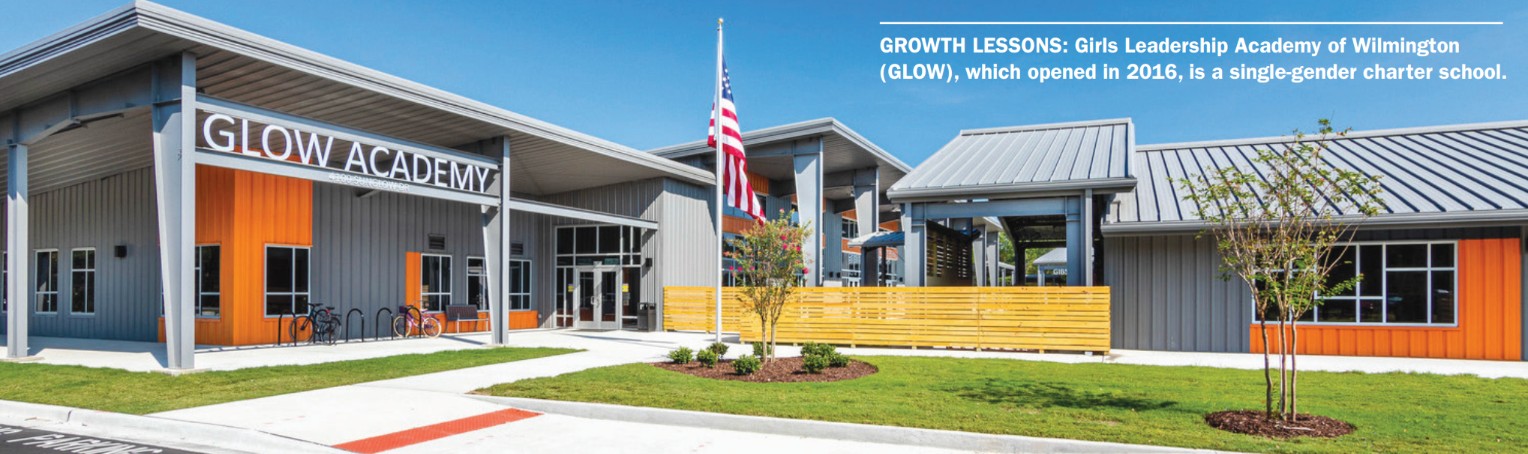
Kate Tayloe, principal of the Girls Leadership Academy of Wilmington (GLOW), which is currently North Carolina’s only single-gender charter school that opened a decade ago, pointed out that the journey to establishing a charter school is no easy feat – and that once established, charter schools have strict compliance standards.
“Public perception is that there’s not a lot of accountability around charter schools,” Tayloe said, “and what I have come to know and understand is that not only in a million ways is there the same accountability that you would have for a traditional public school – in some ways, there’s greater accountability.”
Last year, NCDPI’s Office of Charter Schools surveyed nearly 130 charter schools and identified facility maintenance and acquisition costs as a top concern. As tuition-free public schools funded by a mixture of state and local tax dollars, charter schools have greater flexibility in curricula, programming and staffing. Still, they may face challenges with infrastructure and support services like facilities, transportation and school nutrition.
“This morning, I worked the breakfast line,” said O’Briant. As WSA participates in the Community Eligibility Provision program, O’Briant said, all students get free meals – breakfast and lunch. “I’ll drive the shuttle bus this afternoon,” he added. “Tomorrow our driver’s out, so I’ll drive two routes. We do a little bit of everything.”
As the WSA grows, O’Briant is blunt about the school’s capacity for more students and the struggles nonprofit charters face in facility growth and upkeep.
“One of the things that charter schools aren’t blessed with are buildings,” O’Briant said. “I’ll be honest with you – after this year, it’ll be a little more difficult for us to grow, just because we’re kind of at capacity in our spaces.”
The WSA currently leases space in two places: a facility on Floral Parkway and another at Wesley Memorial United Methodist Church.
According to O’Briant, when the school was first approved and established in Wilmington, it operated out of a building belonging to St. Nicholas Greek Orthodox Church. GLOW Academy had roots in the same space, Tayloe said.
“Before we were in our current building, GLOW was where a lot of schools like GLOW start – in the back of the Greek Orthodox Church across from UNCW,” Tayloe said.
“Not every space can be a school,” she added. “If you’re going to start small and build some traction, you’ve got to raise some money. ... Real estate is certainly not cheap in this town.”
In addition to facility repair and acquisition concerns, NCDPI’s survey also identified funding for exceptional children (EC), which includes students with disabilities, as a top concern among charter schools – as well as struggles finding qualified staff.
“EC staffing is challenging,” Tayloe said. “It is a hard-to-staff position, and there’s no question about that.” She added that she estimates over a quarter of students enrolled at GLOW are EC students.
O’Briant also has concerns for EC funding at WSA.
Currently, the state funds EC services at a per-pupil rate, capped at 13% of a charter school’s or school district’s average daily membership.
The N.C. State Board of Education’s annual report for 2025 identified last year as a period of peak enrollment for students with disabilities for both districts and charter schools compared to the past six years.
“There are certainly a lot of challenges, a lot of work that goes into this,” Tayloe said, “but I also think that there’s so much to celebrate, and that’s part of the truth for us at this time.”

Tech Wilmington: Upcoming Events Calendar
Staff Reports
-
Oct 6, 2026
|
|
Hemp Industry Caught In Legal Weeds
Cece Nunn
-
Oct 7, 2026
|
|
Election 2026 Q&A: N.C. Senate Candidates Share Their Views
Staff Reports
-
Oct 7, 2026
|
|
Carolina HealthWorks Gains Ground As Small Business Health Insurance Costs Rise
Cierra Noffke
-
Oct 5, 2026
|
|
State's Certificate Of Need Requirements Draw Scrutiny
Cierra Noffke
-
Oct 7, 2026
|
|
Candidates vying to represent local districts in the N.C. House of Representatives answer questions on timely topics....

While downtown also benefits from general fund expenditures, the municipal service district (MSD) “is a way of having some additional money...
Now under the ownership of Yousry Sayed, the founder of Quality Chemical Laboratories, Wilmington Machinery is eyeing business growth....

The 2026 WilmingtonBiz: Book on Business is an annual publication showcasing the Wilmington region as a center of business.