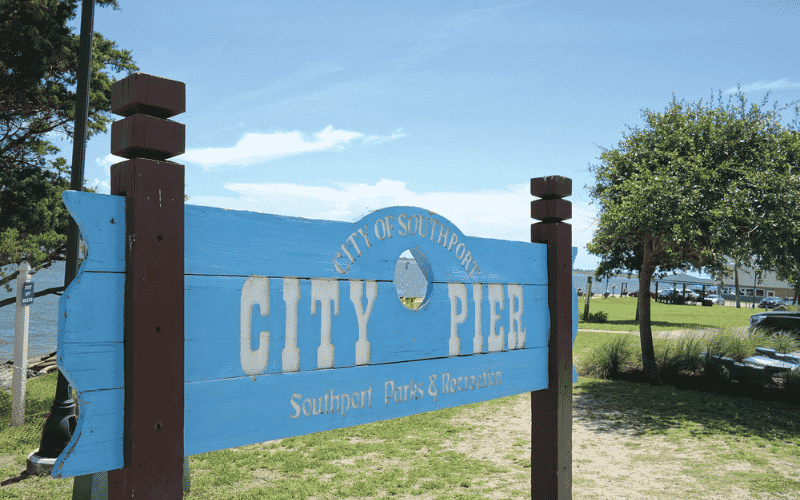
After the locally filmed Amazon original series
The Summer I Turned Pretty debuted, officials saw immediate evidence that the show would drive interest in the area.
“Searches online for Wilmington, North Carolina, peaked exponentially,” said Johnny Griffin, director of the Wilmington Regional Film Commission. “There was no other factor, no other explanation as to what it could be. It was like the only thing in time that has changed is, boom, this show was released last week.”
That was three years ago. These days, with the help of scene locator apps like SetJetters, film and TV fans routinely descend on area beaches, bakeries, bridges and coffee shops, often using their cell phones to recreate scenes from their favorite shows. For the previous generation, that might be
Dawson’s Creek or
One Tree Hill – although streaming availability means there’s always new viewership.
“They have these heap clusters,” Griffin said of the SetJetters’ map that shows visitor activity at locations. “And of the top three places in the whole United States, No. 1 is Southern California, No. 2 is the New England/New York area and No. 3 is Southeastern North Carolina – the Wilmington area.”
Locally sourced onscreen entertainment is just one reason why area tourism has achieved billion-dollar industry status. With such high stakes, officials want to ensure they continue to build on that success without leaving any opportunities by the wayside.
“It’s a surge in interest in the area overall because the product is as great as it seems,” said Megan Buchbinder, hired last year as executive vice president of marketing and strategy for the Wilmington and Beaches Convention & Visitors Bureau.
As warmer weather heats up the next vacation season, officials have a new plan in play, which they are unfolding like a roadmap.
PREPARING FOR PEAK
The group’s first-ever 10-year Tourism Master Plan has been publicly released but is still evolving.
Approved in January 2025, officials began to implement it in July last year, when the fiscal year started.
With four more months to go under the plan’s first fiscal year, local tourism leaders will analyze the upcoming summer peak more closely than ever before.
This year, like always, there will be anticipated bumps in the road for visitors. For example, the N.C. Aquarium at Fort Fisher will be closed for renovations. Similarly, Cape Fear Museum will continue relocating to its new downtown digs, a process slated to be complete by July.
But there will also be plenty of New Hanover County and surrounding areas on display and easily accessible, including, for history buffs, events celebrating the nation’s 250th anniversary, aka the “semiquincentennial.”
The master plan seeks to capitalize on, and effectively manage, all the collective interests – the Riverwalk, beaches, area wildlife, wartime history and more.
Among other goals, planners are working to mete out consumer demand throughout the year, refine Wilmington’s identity relative to competing destinations and, in general, build a more cohesive marketing framework.
“What other industry do we get to pour in other people’s money to help it thrive and grow?” Buchbinder noted.
MARKING THE FIRST YEAR
Buchbinder and Kim Hufham, president and CEO of the Wilmington and Beaches CVB, said the effort is currently working on “quick wins.” Getting area tourism stakeholders on the same page with strategy and messaging was the first big victory, including launching “a unified, soft-season campaign,” Hufham said.
“The goal of that, of course, is to make the area a year-round destination,” she said. “We want to drive visitation from October to May.”
The CVB also hired a community engagement manager – Mark McGrew – to keep the conversation going among community groups.
Looking ahead to May, officials are making improvements to facilitate the flow of people. In addition to visitor booths already in place, the CVB is installing visitor kiosks throughout downtown and at Carolina Beach.
They’re also helping visitors plan.
“We have a mobile trip guide that’s getting a facelift and will be launching in the next couple of weeks,” Buchbinder said in February. “It can help visitors create itineraries before they come. And then it can also help them navigate the destination while they’re here.”
Travelers differ. Some people like to plan every moment of their trips. Some are more spontaneous.
“The kiosks will help those who want to wing it,” Hufham said.
FRAMING THE BIGGER PICTURE

Consultants Clarity of Place, Kimley-Horn and Longwoods International crafted the plan’s recommendations, available at destinationrise.com.
The consultants spotted some opportunities for marketing to address that dovetail with social trends, such as traveling to celebrate a first date or to witness unique natural phenomena, like the Venus flytraps at Carolina Beach State Park.
The advisers even view Wilmington’s similarities to rival destinations, such as Savannah, Georgia, and Charleston, South Carolina, as a positive. That’s because for many potential visitors, this area will be the more affordable option.
But increased demand, while the best kind of problem for any industry to have, is still a problem.
When service is the main product, a constant supply of hospitality labor is essential, officials said. The Wilmington area suffers from the one-two punch of boom growth and seasonality, making it a struggle to find reliable workers at reasonable rates.
“We’re competing with retail; we’re competing with manufacturing; we’re competing with general construction work,” said hospitality consultant Nicolas Montoya, who was the longtime general manager of Blockade Runner Beach Resort in Wrightsville Beach, which was rebranded as Trailborn Surf & Sound. “The hourly wages tend to sometimes put us in a loss.”
Ideally, though, the peaks outweigh the valleys.
SMOOTHING OUT THE PLAN
Montoya, who currently serves as the Greater Wilmington Chamber of Commerce board chairman, said special soft-season events and other incentives could produce enough of a visitor uptick to ensure year-round worker retention.
“If hotels can just go up to 30 or 40 or 50% (occupancy), that significantly changes the amount of the economies of layoffs,” Montoya said.
One challenge is knowing the exact metrics needed for success. Hotels can be secretive about their needs and numbers, including the labor pool they access, Montoya said. His firm, Pontis Hospitality Strategies, is currently working to identify the scope of the labor problem to set strategies and key performance indicators for retention.
“Part of the Tourism Master Plan is workforce development and understanding the needs of our industry,” Buchbinder said.
Through statistical analyses and formal and informal conversations, the CVB will refine its support and advocacy measures.
MANAGING STEADY GROWTH
Currently, tourism is growing at a steady clip of about 2-4% each year, according to room occupancy tax reports, Buchbinder and Hufham said.
Tourism officials will continue to have to make the case to locals that the benefits outweigh the inconveniences. The room tax, for example, helps fund tourism promotion, but it also pays for beach renourishment.
Strengthening community relations, in fact, is an ongoing goal, but officials have slated a stronger push in years three to five of their plan.
Years five to 10 will focus on supporting large capital projects, such as an expansion of the Wilmington Convention Center.
Can there be too much growth, too much of a good thing? Griffin, the film commission director, noted that despite Georgia being a massive film production hub, the Wilmington area outranks it in terms of visitor interest – at least according to the SetJetters app – and that there may be one key reason why.
“Anybody can see that Georgia has beaten the pants off of us as far as actual film production,” Griffin said. “Yet we seem to be leading the way in this film tourism with people actually coming here and seeing stuff. It’s an easier town to navigate. If you come here, you can see film sites, but you can also go to the beach. You can go to a historic area downtown. It’s not just another big city, so to speak.”