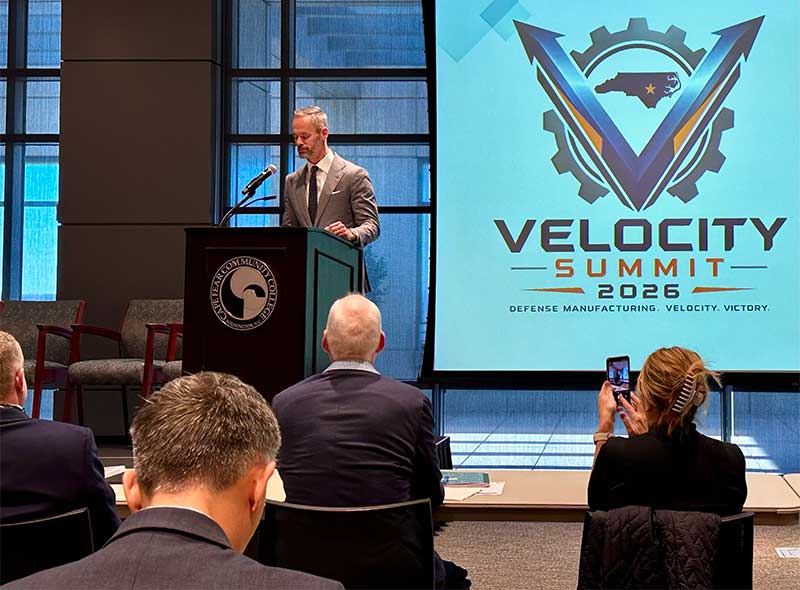
North Carolina is operating below its potential when it comes to the defense economy, according to Lee Lilley, the state’s secretary of commerce.
In North Carolina's new strategic economic development plan, released earlier this year, the state ranked in the bottom half of all states in total defense-related economic activity, Lilley said Tuesday during a keynote speech at The Velocity Summit, a defense industry event hosted by The North Carolina Military Business Center and The Protocase Companies.
“This, despite having the fourth largest active-duty military population, the largest manufacturing workforce in the southeastern United States and the largest concentration of R1 or top-tier research universities in the Southeast,” Lilley said.
But North Carolina has a “generational opportunity” to change that, according to Lilley, by investing in the defense industry and dual-use economic development.
“The need for national defense and the economy increasingly prioritizes rapid commercialization, domestic manufacturing and operational performance,” Lilley said. “So, states like ours, with a coordinated innovation ecosystem, a state that has manufacturing in its bones and a great proximity to warfighters is ready to capture those opportunities if we can work together on that.”
The Velocity Summit brought a range of defense industry executives, members of the military and academics, among others, to the Cape Fear Community College campus in downtown Wilmington on Tuesday for a program that included Doug Milburn, chairman of The Protocase Companies, retired Lt. Gen. Christopher Mohan and panels that featured military officials and industry executives.
The Protocase Companies, which includes Protocase, 45Drives, ProtoSpace Manufacturing and Protomentum, selected Wilmington in 2024 for its first U.S. expansion. The rapid manufacturing firm makes parts for the defense and aerospace industries.
Lilley pointed to the development of the North Carolina Global TransPark in Kinston as one example of a collaborative model that could drive future defense investment in the state. As part of the project, the state invested in the park’s infrastructure while the U.S. Navy signed a long-term agreement for an aircraft maintenance facility on the site.
Lilley said 700 acres of permitted land remain available at the Global TransPark and said state officials are taking steps to work with companies to expedite the permitting process for new projects.
“Delays will not come from state or local governments in this process,” Lilley said. “That is our commitment to people that want to invest in North Carolina.”
He also highlighted the need for dual-use projects that can serve both defense and commercial uses. JetZero, for example, is developing a plane with a blended wing body design at Piedmont Triad International Airport in Greensboro, which will have both commercial and defense uses, Lilley said.
“Recruiting in the defense sector can present some different needs for our economic development teams, but 90% of the pitch is going to be the same, particularly when we talk about dual use, since the companies care about workforce talent, infrastructure, logistics and speed,” he added. “The focus is on building an economic development platform that supports rapid commercial scaling and ultimately defense surge capacity.”
Mohan, who formerly served as the commanding general of U.S. Army Materiel Command, said boosting the country’s defense industrial capacity will require closer partnership between government and industry. He said the main problem stems from reduced capacity due to a decrease in U.S. manufacturing jobs, fewer suppliers and a growing backlog, not a lack of funding or demand.
“We don’t have a money problem,” Mohan said. “We have a capacity problem in this nation that started about 40 years ago; we started shedding capacity and sending it to other places.”
He noted other barriers to meeting demands include aging infrastructure, outdated procedures and long qualification timelines. Mohan said solutions could include long-term demand signals, increased data sharing, production lines that are more responsive to demand and more advanced manufacturing partnerships.
“It's about readiness,” Mohan said, “and at the end of the day, what we cannot lose sight of is that every time we cannot produce a part for one of our combat systems, there's a soldier out there that's going … ‘Why is this thing broken, and I cannot get a repair part?’”