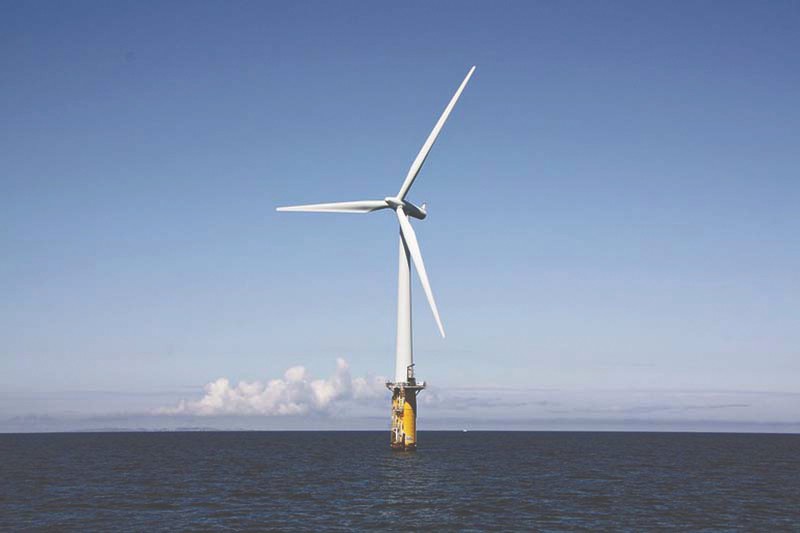
A stretch of ocean off the coast of Brunswick County made national news earlier this year when the Trump administration announced plans to pay French energy company TotalEnergies to relinquish its lease in the area, along with another lease off New York.
The deal has drawn mixed reactions from groups that for years have monitored the proposed offshore wind projects in the Carolina Long Bay lease area, a more than 110,000-acre site nearly 20 nautical miles off Bald Head Island.
In 2022, TotalEnergies subsidiary TotalEnergies Renewables USA LLC and Duke Energy subsidiary Cinergy Corp., formerly Duke Energy Renewables Wind LLC, won bids for leases within Carolina Long Bay from the Bureau of Ocean Energy Management.
It was part of the Biden Administration’s goal to deploy 30 gigawatts of offshore wind energy capacity by 2030.
The current Trump Administration has taken an opposite stance on offshore wind, last year pausing leases for five large offshore projects – a move that led to lawsuit challenges.
In the recent agreement with the federal government, TotalEnergies committed to relinquishing its offshore leases and investing nearly $930 million – the value of the leases – in U.S. production of oil and natural gas, including liquefied natural gas, according to the U.S. Department of the Interior, with the federal government planning to “reimburse the company dollar-for-dollar.”
TotalEnergies paid $133 million for its roughly 55,000-acre lease off the coast of Brunswick County and $795 million for its approximately 84,000-acre lease in the New York Bight area, according to the Department of the Interior.
In a news release, TotalEnergies stated that “studies on these leases have shown that offshore wind developments in the United States, unlike those in Europe, are costly and might have a negative impact on power affordability for U.S. consumers. Since other technologies are available to meet the growing demand for electricity in the United States in a more affordable way, TotalEnergies considers there is no need to allocate capital to this technology in the U.S.”
The announcement is the latest setback for the development of offshore wind energy in North Carolina, said Katharine Kollins, president of the Southeastern Wind Coalition.
“This is an unprecedented move by the federal government,” she said.
The North Carolina lease areas had the capacity to generate about 1.3 gigawatts of electricity, enough to power roughly 300,000 homes, federal officials had said.
Removing that energy generation potential could hurt energy diversification efforts in North Carolina, Kollins said.
“Grid diversity is incredibly important because every resource has a role to play, even those that we consider base load, like nuclear, natural gas, coal; they’re not always optimized,” she said. “All of the resources that we have need to go offline for maintenance. Sometimes that’s long-term maintenance and so having that really diverse set of fuels is critical to reliability and affordability.”
Some Brunswick County residents such as Cane Faircloth, a founding member of the N.C. For-Hire Captains Association, celebrated TotalEnergies’ deal with the Trump administration. Faircloth is the owner and captain of Ollie Raja Fishing Charters in Holden Beach.
The lease area sits over a part of the ocean that’s prime for fishing, Faircloth said.
“It is the best fishing grounds that we have off of the Wilmington area. They picked the worst possible spot they could have picked,” Faircloth said about the lease area.
After the leases were bid out, Faircloth said he and others in the group began contacting with other captains around the world in places where offshore wind has established a presence. These conversations raised concerns about the creation of “dead areas,” Faircloth said, on the ocean floor.
According to the National Oceanic and Atmospheric Administration’s website, offshore wind has the potential to change the distribution, abundance and species composition of fish in an area, along with displacing fishermen from traditional fishing areas, among other impacts.
Members of the N.C. For-Hire Capt. Association also had concerns about the impacts offshore wind could have on tourism to Brunswick County beaches – a key business driver for the area’s for-hire charters.
“Of course, us being fishermen and citizens,” Faircloth said, “that was the last thing we wanted to see, was our fishing industry and tourism industry affected by this.”
Some local municipalities, including the town of Bald Head Island and Brunswick County, also expressed concerns about the project’s early tourism impacts.
With the TotalEnergies lease off the table, two offshore wind leases remain in North Carolina – the lease in Carolina Long Bay from the Duke Energy subsidiary and energy company Avangrid’s lease off the Outer Banks in Kitty Hawk Wind South.
Last year, Duke Energy filed a report with state regulators that determined offshore wind was not presently “cost-competitive” for the company. In a recent statement, Duke Energy spokesperson Riley Cook wrote that the company will “continue to evaluate next steps as it relates to the Carolina Long Bay lease.” Faircloth said his group will continue monitoring the Duke Energy lease.
Kollins said she sees the Carolinas Resource Plan, an energy generation framework for the state that’s developed by Duke Energy and the N.C. Utilities Commission, as a potential hurdle to future offshore wind energy development.
“For offshore wind to move forward in the state, those two entities both need to propose and approve an offshore wind project,” she said, “in order to give developers the certainty they need to move forward with their offshore wind investments.”
As for the future of the former TotalEnergies lease area, Kollins said she doesn’t expect to see it bid out to a new wind energy developer anytime soon.
“Because the administration isn’t issuing any new permits for any kind of offshore wind activity,” she said, “they’re certainly not going to release the area under this administration.”