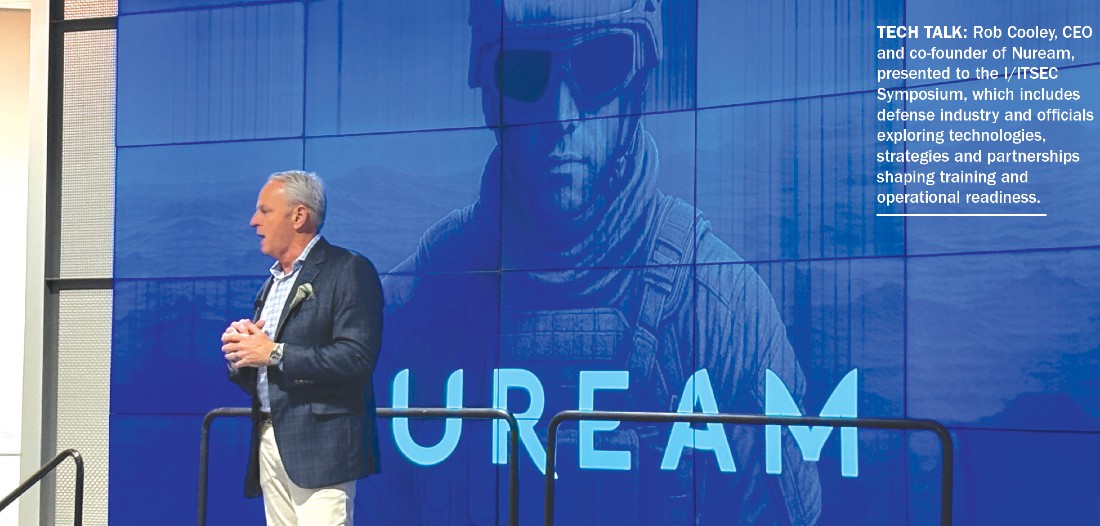
It’s been a big year for Nuream, and CEO and co-founder Rob Cooley expects that momentum to keep swinging forward.
“We want to be in the commercial market about a year from now with our first pillowcase, plus a SaaS (software-as-a-service) model with a dashboard and clinical informatics and predictive analytics,” Cooley said.
Nuream was one of 10 startup companies tapped for the RIoT Accelerator Program this year, a 12-week program for disruptive technology startups looking to scale. The company was also among 21 semifinalists for NC IDEA’s spring 2026 SEED grant cycle.
Nuream joined the National Sleep Foundation’s SleepTech Network earlier this year, giving the company access to national expertise and data about sleep.
Cooley said the firm’s funding journey is just beginning.
“We are validating through customer experience the use model of our second set of prototypes and are working on demonstrating the efficacy of the science,” he said. “We’re raising money and have won our first grants.
“We are at that step before the hockey stick inflection, and the next couple of months are really going to be exciting for us,” Cooley added.
The Wilmington-based company specializes in sleep tech, which Cooley admits is a broad category. Cooley and his co-founders, Nathan and Lauren Munton, are hyperfocused on improving sleep, not just by selling nice mattresses, but by developing data-driven tools.
Nuream’s goal is to collect accurate sleep data through minimally invasive electroencephalogram (EEG) technology, which measures the brain’s electrical activity, and create subsequent dashboards and profiles for users and organizations to understand sleep patterns and long-term sleep trends. The company also sells bed bases, sheets, pillows and mattresses “with a scientific edge.”
“Most of the current publications say that the (sleep) market is about $120 billion per year and growing between 5 to 8% per annum,” Cooley said, “which means it’s still highly enticing to startups and investors, but it hasn’t gone through a lot of transformation in a little bit.”
In 2025, Nuream received a grant from the Department of Defense-backed Advanced Functional Fabrics of America (AFFOA) to develop its second fabric-as-a-sensor pillowcase prototype, embroidered with strips of electro-sensing materials. In partnership with the University of North Carolina Wilmington’s College of Health & Human Services and College of Science & Engineering, Nuream has been testing its prototype, but has not publicly released its findings.
According to Cooley, the research focuses on two primary questions: whether neuro-sensing pillowcases can accurately collect data at all and whether that data demonstrates meaningful correlations.
“That correlation is very high,” Cooley said. “We’re still in advance of going public with the numbers, but it is better than we had anticipated at this point, which is great, because that’s the technical hurdle.”
Since its founding in 2023, Nuream has pivoted to a four-pillar model, Cooley said. The first pillar is developing the neuro-sensing material, accelerated with the AFFOA grant. The prototype’s efficacy will determine the success of the subsequent pillars, including managing and curating sleep data, applying artificial intelligence models and algorithms to interpret that data and lastly, delivering actionable insights.
While the EEG-embroidered pillowcase and dashboards certainly have potential applications in clinics and hospitals, Nuream’s focus is on individual “sleep-starved” users.
“Today’s (sleep) solutions are invasive, uncomfortable and inaccurate,” Cooley said. “A lot of folks have a wearable with a sleep app, but less than 10% wear their sleep device to sleep. Nobody wants to go to a sleep clinic and have stuff stuck to your head.”
Cooley said the technology could disrupt the traditional sleep clinic model by allowing users to collect accurate data from home, rather than spending multiple nights in a lab.
The neuro-sensing materials in the pillowcases quietly collect brainwave data during sleep cycles, which is then analyzed using AI and contextual data. The resulting insights aim to help users improve sleep habits. Over time, Cooley said, the long-term data collection could also identify disturbances or anomalies that may signal other health concerns.
The pillowcase is designed to collect as much information about sleeping habits as possible, although users can choose how and when data is collected – and with whom it’s shared.
“We will collect the right data, not the wrong data, and not more data, but the right data seamlessly to you. So, we don’t change any human behavior,” Cooley said. “You go to sleep on your pillow in your bedroom at night, and then we protect, curate and then we deliver the right insights and recommendations to you.”