Two Wilmington-rooted companies are raising the stakes on sustainability.
Both Atlantic Packaging, a packaging solutions firm, and Green Assets, a land management and consulting firm, are embracing strategies that integrate sustainability directly into their business models.
Beyond a one-time solution, each firm is betting on the eventual evolution of each industry – and the market’s role in putting a price on sustainability.
CLOSING THE LOOP ON PACKAGING

Atlantic Packaging, which has been operated by three generations of a North Carolina family, has evolved from a small weekly newspaper to one of the largest privately owned packaging firms in the country.
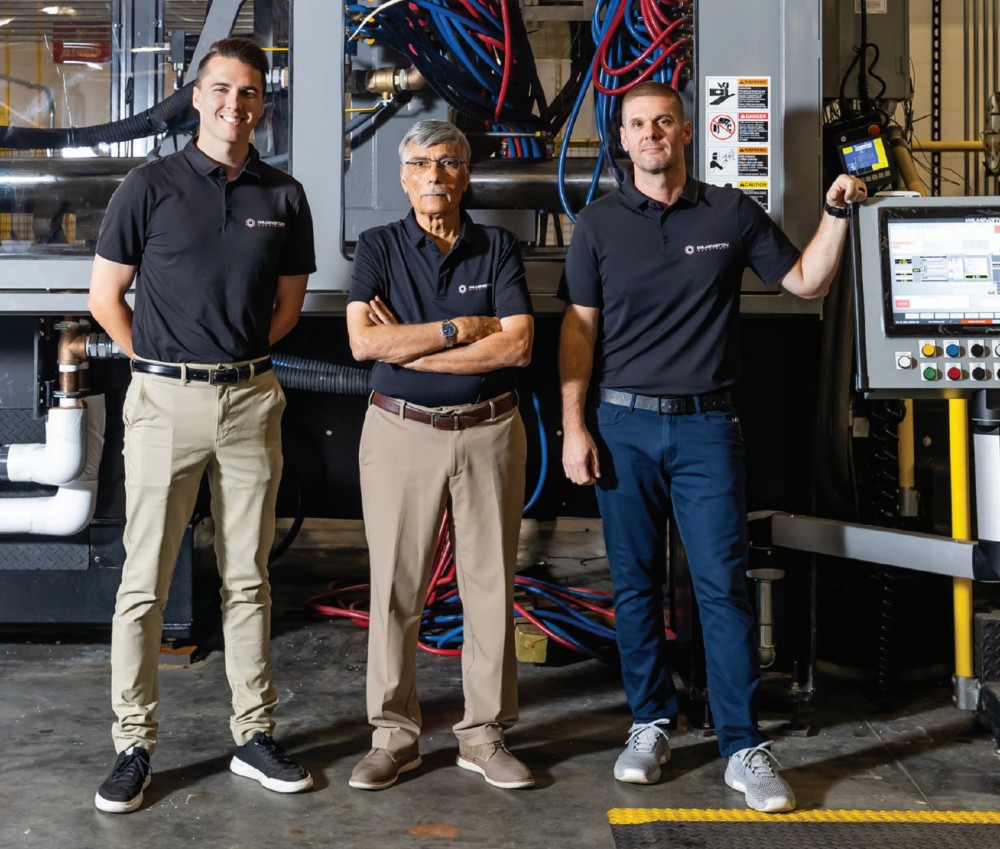
Led by company president Wes Carter, the firm produces packaging materials from stretch film to shrink sleeves, corrugated cardboard to cartons. And it has taken a hard stance in its approach to sustainability, according to Carter.
While the firm certainly plays a hand in developing single-use products, like stretch wrap, it has also committed to maximizing the use-cases of its products, creating sustainable alternatives and evolving the packaging industry from the inside out, Carter said.
“Industry can create incredible benefits, but industry has also created a lot of unintended consequences that we are facing today,” he said. “My perspective is, industry is the only mechanism that can actually shift these things as well.”
According to Caroline DeLoach, Atlantic Packaging’s director of sustainability, the company uses two core principles in its approach: 1) to use as little material as possible and 2) to create closed loops wherever possible.
Atlantic Packaging takes a “circular economy” approach, instead of a traditional linear approach, DeLoach said. Instead of using resources to create products that are disposed of after a single use, the firm focuses on keeping materials in circulation longer, whether through reuse or recycling.
“Within life cycle thinking (LCT) of any given product, you can assess the water use, the energy use, the greenhouse gas footprint, the waste potential, the ecotoxicity, and sometimes these things can stand at odds with each other,” DeLoach said. “There’s rarely just one ‘most sustainable’ option. I wish that it were that simple.”
Carter added that the firm rarely uses a “black-and-white” approach to packaging solutions.
“This is super nuanced,” he added. “Certain types of plastic are incredibly efficient. … In those cases, we’re not focused on replacing them; we’re just focused on closed loops. There are other areas like e-commerce, where that’s low-hanging fruit to migrate to more natural materials like fiber-based materials.”
Atlantic Packaging launched its core sustainability initiative, A New Earth Project, in 2021, with the mission of ridding “the world’s oceans, lakes and rivers of plastic pollution.”
Through collaboration and research, A New Earth Project aims to find sustainable packaging solutions for common single-use packaging products. The catalog includes items such as fiber-based zip ties, water-activated tape and seaweed-based Sway Polybags, intended as a replacement for plastic.
DeLoach said Atlantic Packaging occupies a middle ground in the supply chain, meaning it can draw from a variety of suppliers while staying data-informed and impartial.
“That gives me a kind of academic honesty with our customers to talk about the sustainability merits of different kinds of packaging,” she said, “instead of feeling beholden to spinning a sustainability story about a specific material because we happen to make it.”
DeLoach is optimistic about the potential of policies to improve the industry, pointing to California’s extended producer responsibility (EPR) program under California State Senate Bill 54, which puts the financial and physical responsibility for managing single-use products and waste on the companies that sell or import them. The program comes with incentive bonuses and penalty fees for companies.
“I’m a big believer in the ability for policy to make change, but I’m even more of a believer in market-based policy being able to make change,” said DeLoach. “And that’s what excites me about EPR. … It’s creating economic incentives, and that’s big.”
Carter said, “We’re not going to create a sustainable packaging supply chain that is adjacent to the current packaging supply chain. What we can do is harmonize around values, … identify technologies that we can integrate with the current supply chain, and over six, eight, 10 years, we won’t create a new supply chain; we’ll evolve the current one.”
A PRICE ON CONSERVATION

The forests of the Southeast are also known as the country’s “wood basket,” as they contain hundreds of tree species and produce over half the country’s timber.
Another firm based in Wilmington, Green Assets, is working to preserve parts of those forests by turning them into carbon projects for landowners.
According to Green Assets CEO Bailey Evans, the firm manages almost a quarter million acres of forestland in the Southeast for carbon credits.
Green Assets works with plenty of landowners who own older forests, Evans said, and there’s been new interest from landowners seeking a legacy commitment.
If a landowner wants to keep land in the family for generations, engaging in a carbon credit project can ensure the land stays green and protected for decades, he said.
The company was founded by Hunter Parks in 2010, after Parks successfully used his own family land to complete a carbon offset project.
“Because of that experience, he founded Green Assets, and our tagline is that we like working with landowners because we own land,” Evans said. “We know what the experience is like to sit across the table from someone pitching you an environmental project.”
In 2015, the company announced it had completed the first-ever compliance-grade avoided conversion carbon offset project in the United States, covering roughly 3,700 acres near Charleston, South Carolina.
After Parks died in a plane crash off the Outer Banks in 2022, Evans, then vice president, stepped into the CEO role to continue Parks’ legacy.
For Evans, carbon credits are a type of “conservation finance,” allowing landowners to reap monetary benefits from their land without converting it into a timber forest.
When a landowner agrees to an avoided conversion project, or a commitment to keeping land forested, they sign a conservation easement legally bound to the land’s deed.
“That’s a pretty big step for landowners to do conservation easements,” Evans said. “It often gets underplayed.”
Green Assets designs the entire carbon project, collects data and works with registered third-party auditors to ensure the data complies with a myriad of standards.
Crews gather forestry data by taking a carbon inventory or measuring trees within a certain diameter around each plot of land.
“Once we collect that data, we have to quantify the carbon that’s stored on-site and model the forest growth moving forward to figure out how many metric tons of carbon dioxide equivalent are stored on the property and will be stored on the property as the forest grows,” Evans said.
The verification process typically takes a year, Evans said, to meet the industry’s rigorous compliance standards. Auditors must remeasure a broad sample of plots to verify each project, and then the projects move through a carbon crediting program that issues the carbon credits.
As for who pays, Evans said Green Assets shoulders the cost of the project – which means it will only reap benefits if the project is successful.
“The whole point of doing that was basically to say to the landowner, ‘We understand that this is a big commitment for you, and we want to demonstrate that we have some skin in the game here,’” Evans said.
“We have a 100% success rate because of that business model,” he added. “We’ve never judged a project that’s not going to be able to be seen all the way to the very end.”
Green Assets also offers “improved forest management projects” targeted toward landowners who want to keep foresting their land while generating carbon credits with practices that reduce logging impact and can yield longer-term wood products.
“We’re proud supporters of the forest products industry,” Evans said. “It’s important that mills are fed with high-quality wood, but certain landowners might not want to (harvest) on a scale that would be required to generate the amount of income that they were hoping for, and that’s where carbon (credits) can come into play."
ROOTED RESPONSIBILITIES
From grassy marshlands abundant with life to its rich forestlands, the Southeast harbors many well-known natural elements, including thousands of species of trees, birds, fish, plants and animals.
While Atlantic Packaging, which, as a privately run firm, doesn’t have to report its sustainability impact or indirect greenhouse gas emissions, Carter said it does so because of a moral fortitude established by his grandfather and an obligation to the place he once called home.
“The whole awakening around the impact that industry is having, the plastic pollution crisis and how it’s affecting our oceans, is a direct derivative of growing up at Wrightsville Beach,” he said. “If it weren’t for Wilmington and Wrightsville Beach, would any of this be happening? I doubt it.”
Similarly, Green Assets takes responsibility for properly conserving hundreds of acres of forest land, primarily privately owned.
While both industries continue to evolve and the responsibility of sustainable packaging and conserved land grows, those studying the problem say one thing remains true: The work is far from over.
Editor's note: The online version of this story includes clarifications on the timeline for carbon projects and how projects are audited.