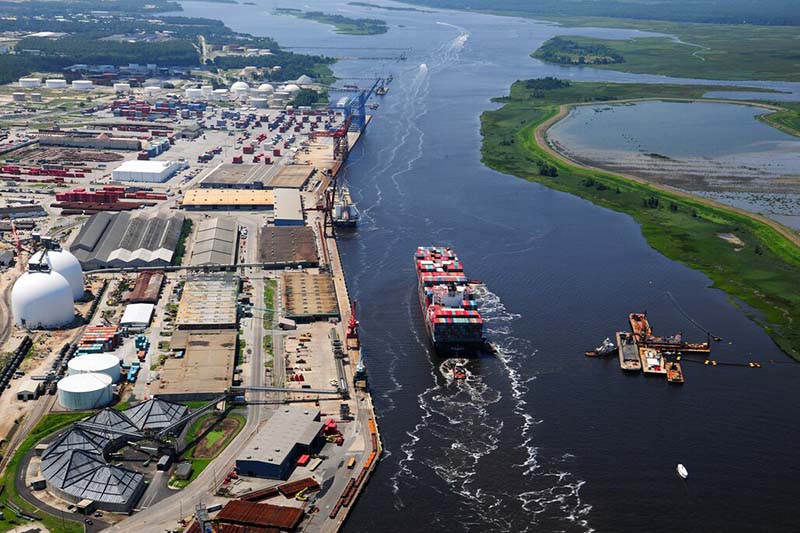
North Carolina’s Division of Coastal Management issued an objection this week to the proposed deepening of Wilmington's Harbor, citing concerns and a lack of information about the project’s potential environmental impacts.
The $1.35 billion project, spearheaded by the U.S. Army Corps of Engineers (USACE) and the N.C. State Ports Authority, would deepen Wilmington’s harbor from 42 feet to 47 feet. It would also extend and deepen navigation channels adjacent to the Port of Wilmington.
Port officials have said the project could boost the Port of Wilmington’s competitiveness, allowing it to accommodate larger, fully loaded ships.
With DCM’s objection, USACE could postpone final federal action on the project and work through a dispute resolution process outlined in federal law. Cayton said the USACE is in the process of reviewing DCM's findings with the N.C. State Ports Authority to determine how they will proceed.
In September,
the USACE issued drafts of a report and an environmental impact statement on the proposed harbor deepening, which was followed by a public comment period and additional review.
The Division of Coastal Management (DCM), for example, began reviewing the USACE's findings to ensure the proposed project met the enforceable policies of North Carolina’s coastal management program. In mid-January, USACE asked DCM, a division of the N.C. Department of Environmental Quality, to pause its review after DCM raised concerns about the report.
During the pause, the USACE and DCM discussed the concerns and possible resolutions. On Feb. 16, the USACE informed DCM it wanted the division to resume its consistency review. DCM issued the findings on Tuesday in a letter addressed to Bret Walters, chief of the planning and environmental branch of the USACE’s Wilmington District.
In an emailed statement on Wednesday, Jed Cayton, a public affairs specialist with the USACE, called the objection from the DCM “disappointing.” According to Cayton, the USACE has worked with state and federal partners on the project for the past three-and-a-half years.
“During this process, we have had numerous opportunities for not only public engagement but also input from our state and federal resource agency partners,” Cayton wrote. “For example, our project team formed Technical Working Groups (TWG) for different aspects of the project, such as cultural/historic resources, wetlands and beneficial use of dredged material. These TWGs were formed at various times through the development and drafting of the project’s Environmental Impact Statement (EIS).”
According to Cayton, the TWGs included members from federal and state agencies with various regulatory responsibilities and concerns, along with several subject matter experts who provided feedback on available information, wetlands model selection, model application strategies and modifications to improve and verify the accuracy of the models’ inputs and outputs.
“Given all the integration and engagement throughout this process,” Cayton stated, “the objection provided at this late stage in the process is disconcerting.”
A spokesperson with North Carolina Ports said in an emailed statement that the Ports Authority values DCM’s work and respects the concerns raised in the objection.
“We also appreciate the continued support of the U.S. Army Corps of Engineers as we review the content of this letter and determine next steps,” the spokesperson wrote. “Regardless of the path forward, we will continue to deliver on our mission to enhance North Carolina’s economy by serving as a gateway to global markets.”
DCM's objection cites several concerns about the project, including a lack of information about various items. The agency’s review drew upon the USACE’s own consistency determination and environmental impact statement, along with stakeholder and public comments.
In its evaluation, DCM raises concerns about a lack of information from the USACE about PFAS, or per- and polyfluoroalkyl substances, chemicals that have polluted the drinking water supply in the Cape Fear River and could be found in sediment that's set to be dredged as part of the harbor deepening.
“The (draft environmental impact statement) does not evaluate the potential for contaminant resuspension during dredging and the resulting fate and transport of these chemicals into nearby water bodies and land areas,” DCM states in its report.
“Additionally, the placement of PFAS-containing dredged material along riverbanks, back barrier island areas, surrounding bird island areas, marshes in the Cape Fear River, beach nourishment in New Hanover and Brunswick counties, fish habitat rock placement and other areas are of great concern,” the report continues. “The potential exposure to humans and wildlife, water quality impacts and long-term effects to the environment and ecosystems must be considered.”
The report from DCM also raised concerns about the impact the harbor deepening could have on existing flooding issues and ongoing sea level rise across the region. The DCM report states that the USACE assessed the impacts of the channel deepening and sea level rise largely in isolation, thus potentially underestimating how the project could accelerate tidal flooding and storm surge.
The DCM report also raises questions about the impact of placing dredged materials in wetland areas in the region and whether the proposed mitigation will offset impacts from the project. Other concerns include the loss of fish and freshwater wetland habitats, shoreline and wetland erosion and economic uncertainties surrounding the project, such as changing global shipping patterns and supply chains.
“These economic unknowns, when paired with the environmental and community risks identified throughout this letter, lead DCM to conclude that the economic rationale for the proposed project remains insufficiently substantiated and fails to demonstrate that the purported benefits outweigh foreseeable costs to North Carolina’s coastal economy and public welfare,” the report states.
Environmental
advocates in the Cape Fear region have raised concerns about the effects the project could have on coastal habitats across the region, and in a news release on Wednesday, the Southern Environmental Law Center praised DCM's findings, stating that the project "would risk substantial harm to coastal resources and communities."
Local governments have also voiced concerns about the harbor deepening. At its Feb. 10 meeting, for example, Oak Island’s Town Council approved adding the town to a joint regional statement that calls for the inclusion of mitigation protocols in the harbor deepening proposal.
Others, including the city of Wilmington, the city of Southport, the village of Bald Head Island, the town of Leland and the town of Kure Beach, have formally urged state and federal officials to further review the harbor deepening.
According to a news release issued Wednesday, DCM remains “committed to working with the Corps to try to resolve the concerns detailed in this objection,” along with the State Ports Authority, federal partners, stakeholders and the public."
“The Division of Coastal Management’s decision will protect public health from forever chemicals like PFAS and preserve treasured coastal resources in the lower Cape Fear River Basin,” Division of Environmental Quality Secretary Reid Wilson wrote in the release. “If the Army Corps of Engineers can make changes to its proposal to protect people’s health and the environment, we are at the table to continue this conversation.”