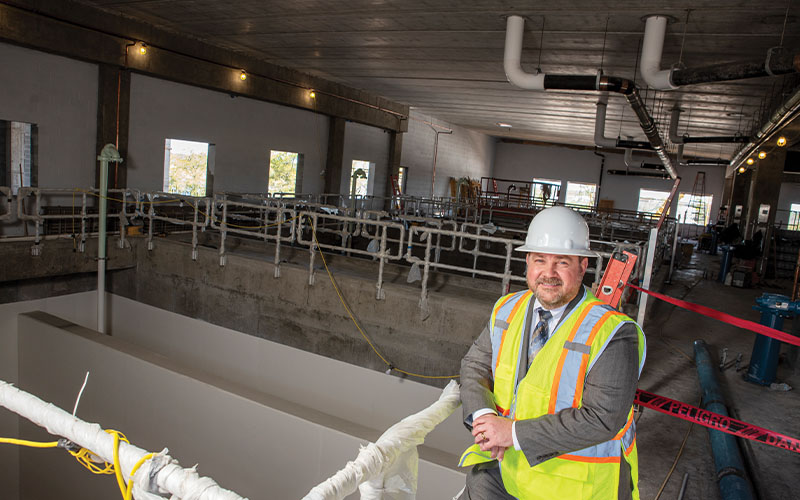
The pipes line a brightly lit hallway imposingly – eight green and blue-painted filters. Cape Fear Public Utility Authority (CFPUA) operates eight of these deep-bed Granular Activated Carbon (GAC) filters at its Sweeney Water Treatment Plant, which is responsible for delivering clean drinking water to about 80% of CFPUA’s customers.
The GAC filters’ job is an important one: to filter out per- and polyfluoroalkyl substances (PFAS) found in the Cape Fear River.
To date, CFPUA has spent $91 million to address PFAS, including the installation of the filtration system, the yearly maintenance of the GAC filters, lab testing and legal fees, a bill racked up over the course of its nine-year lawsuit against upstream chemical manufacturer Chemours.
CFPUA sued the company, a spinoff of Delaware-based DuPont, in 2017, after the discovery of GenX in the drinking water – a byproduct believed to originate from chemical dumping at Chemours’ plant near Fayetteville, about 100 miles upriver from Wilmington.
Nearly a decade later, the battle is still a long way from being over.
“Resolution of the lawsuit is likely several years away, and predicting what that might entail, including any monetary award, is not possible,” said CFPUA Executive Director Kenneth Waldroup.
“CFPUA is a public entity, funded by ratepayers and operating without any profit,” he added. “CFPUA customers would be the beneficiaries of any award received from the lawsuit.”
In 2019, a court-enforceable consent order between Chemours, Cape Fear River Watch and the N.C. Department of Environmental Quality (NCDEQ) required Chemours to take several measures to mitigate PFAS pollution, including installing a thermal oxidizer, conducting regular testing and public reporting.
CFPUA’s lawsuit has since been consolidated with Brunswick County, Lower Cape Fear Water & Sewer Authority and the town of Wrightsville Beach. CFPUA filed a follow-up suit in March 2023 against DuPont and Chemours in the state of Delaware, and in April 2025, CFPUA filed a formal objection to Chemours’ petition to keep sensitive court documents sealed, which a judge has since upheld.
Chemours is seeking approval from NCDEQ for an expansion at its Fayetteville Works plant, which Wilmington-area officials opposed in 2025 with formal resolutions.
Despite the public outcry surrounding the discovery of PFAS, ultrashort-chain PFAS are still being found in locally treated water and near Chemours’ Fayetteville facility, according to Cape Fear River Watch.
“These ultrashort-chain PFAS … are just PFAS that are not getting removed by CFPUA’s drinking water,” said Southern Environmental Law Center (SELC) attorney Jean Zhuang. “It’s the same story as what happened with GenX, and it’s the same story where the company has concealed its pollution again.”
ULTRASHORT-CHAIN PFAS: THE NEXT FRONTIER
Cape Fear River Watch’s Kemp Burdette told the Business Journal in December that tests conducted in October indicate Chemours is still contaminating groundwater in Fayetteville and in Wilmington, specifically with ultrashort-chain PFAS compounds such as trifluoracetic acid (TFA) and perfluoropropionic acid (PFPrA), of which not much is conclusively known.
The challenge in addressing ultrashort-chain PFAS pollution lies in the lack of specific drinking water standards and the ongoing emergence of toxicology and health data, according to researchers.
Phil Brown, co-director of the PFAS Project and distinguished professor at Northeastern University, said there are over 14,000 known PFAS compounds.
“Most of them are not well studied, but they keep being produced all the time,” Brown said.
“Even five years ago, you didn’t see anybody talking about TFA,” Brown added. “And actually, when it began to be talked about, some industry representatives were saying that this is really a naturally occurring substance, and it’s not even a PFAS.”
As ultrashort-chain PFAS compounds are very small, it’s difficult for CFPUA’s GAC filters to catch them all.
CFPUA has reported trace amounts of ultrashort-chain PFMOAA and PFPrA, and TFA levels in treated water.
“The filters are doing an excellent job at treating the PFAS we have the most health information about,” CFPUA’s website states. “These include PFOA, PFOS and GenX. There isn’t much, if any, health information available for PFMOAA and PFPrA.”
In a study analyzing blood samples from Wilmington residents taken between 2010 and 2016, before CFPUA’s GAC filters were installed, researchers from N.C. State University found high levels of PFMOAA, PFPrA and TFA in almost every sample.
Today, Jane Hoppin, an environmental epidemiologist and one of the study’s lead researchers, is confident she wouldn’t find any PFMOAA in current blood samples due to restrictions in the consent order. CFPUA also reports consistently keeping PFMOAA below 10 ppt in treated water.
Even so, Zhuang said, knowing that residents were exposed for so many years and that amounts of TFA and PFPrA were found during recent sampling is concerning, especially as Chemours seeks an expansion.
A 2022 National Academies study reported that PFAS exposure may be linked to endocrine disruption, thyroid disease, kidney disease, high cholesterol, immune function and fertility, among other issues.
Hoppin emphasized that although PFAS are often called “forever chemicals” because of their long-term presence in the environment, they are not forever in the body, and ultrashort-chain PFAS tend to pass through more quickly. But as Brown noted, we are consistently exposed to both long-chain and ultrashort-chain PFAS.
“One of the things also the industry says is, look, the half-life in the human body of some of the long-chain traditional PFAS is months,” said Brown. “And if you start to look at the short chain, they may be just a few days... The point is, you’re taking it in all the time.”
EXPANSION PLANS
Chemours submitted a revised air quality modification application in August, requesting an increase in output for two fluorinated vinyl ethers units at its Fayetteville facility, which the application states may affect production in other process areas at the facility. NCDEQ is currently reviewing the application.
“Any draft permit, comment periods or permitting decisions will be communicated to the public as part of our public participation plan,” said NCDEQ Public Information Officer Shawn Taylor in an email to the Business Journal in March.
Chemours also filed for a wastewater discharge permit renewal in April to continue discharging from one of its outfalls, which Cape Fear River Watch and SELC oppose, given the discovery of nearby ultrashort-chain PFAS pollution.
The EPA hasn’t certified a test method for TFA or PFPrA. NCDEQ’s Division of Water Resources has requested Chemours begin testing for those two PFAS compounds with modified test methods, Taylor said.
Chemours, in an email to the Business Journal, said that the company “proactively and voluntarily developed a new advanced analytical method to detect and quantify TFA at very low levels previously not possible.”
“We offered to share this methodology with regulators, including NCDEQ, and have agreed to sample and report TFA and PFPrA levels to NCDEQ starting this summer,” said Jess Loizeaux, Chemours’ spokesperson.
“Available toxicological data and risk modeling indicate these compounds are not believed to be harmful to human health or the environment at levels detected,” Loizeaux added.
According to Loizeaux, the expansion is projected to decrease the site’s fluorinated emissions by approximately 9%.
CFPUA’s latest efforts to improve the region’s drinking water have included extending water mains to neighborhoods relying on private wells contaminated with PFAS, using $35 million awarded through state and federal grants.
“CFPUA continues to pursue funding for extensions to additional neighborhoods impacted by PFAS,” Waldroup said. “We strongly encourage residents to contact Chemours to have their wells sampled.”
See other stories on Law:
Lawsuit Continues Over PFAS Impacts
Opinion: Opioid Funds Driving Real Change
Attorney Gets Law of the Land
Area Attorneys Chosen for 2026 Legal Elite List
Area Attorneys Chosen for 2026 Super Lawyers List
Attorneys Carve Out Legal Niches